


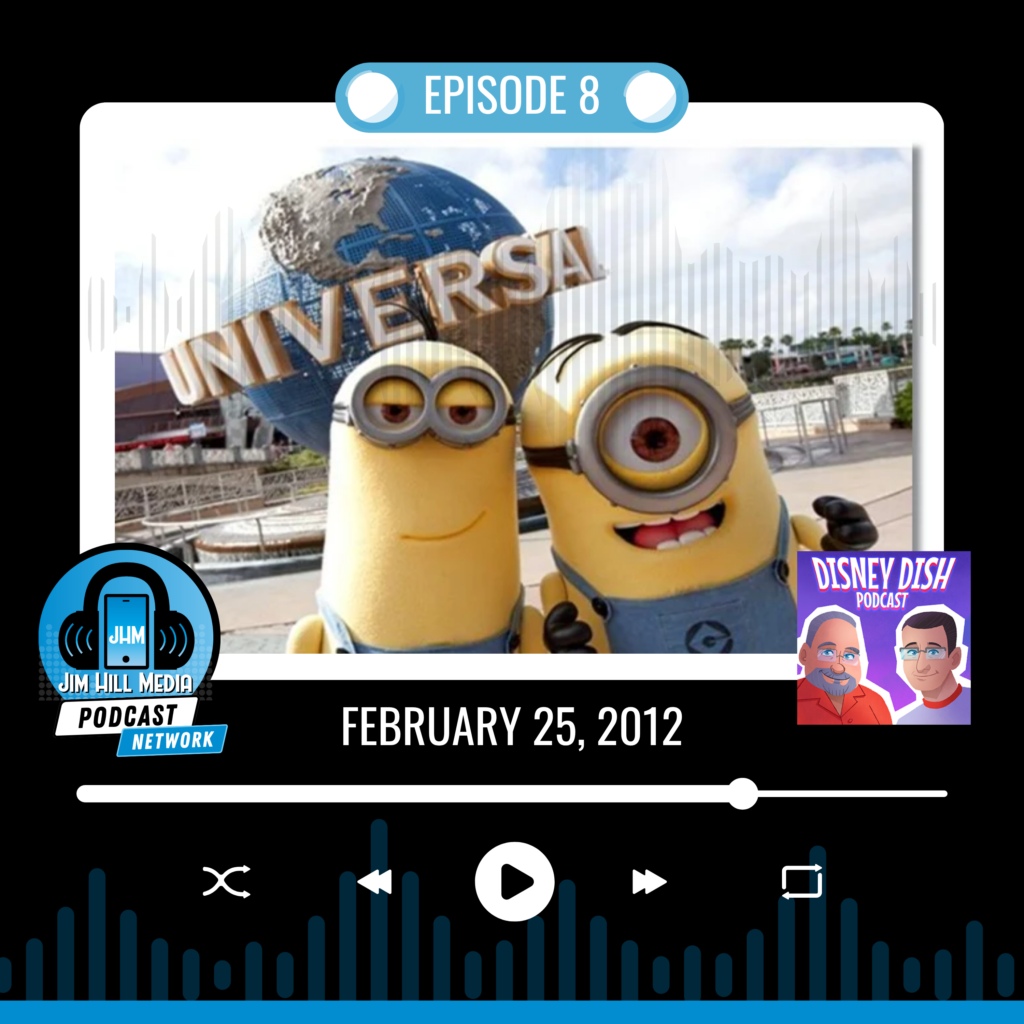
Join theme park experts Jim Hill and Len Testa as they walk through the gates of Universal Studios Florida for a fascinating look at the park’s architecture, design philosophy, and evolutionary history. In this episode, the duo explores everything from the counterintuitive layout of the park’s Hollywood and New York backlots to the top-secret, game-changing expansion plans for Diagon Alley. Along the way, they share incredible, behind-the-scenes stories about Michael Eisner’s early involvement, Steven Spielberg’s legendary contract deals, the technical failures of opening day in 1990, and a canceled “Tooniversal” theme park that almost brought Batman and the Looney Tunes to Central Florida.
Universal’s Florida Foreshadowing and the Road to Diagon Alley Transcript
Len Testa: It’s another beautiful day here in downtown Orlando. I’m at Universal Studios with Jim Hill. This is another edition of the unofficial guide Disney Dish podcast with Jim Hill. Jim, welcome to Universal Studios Orlando. Nice to be back here. It’s nice. So we just walked through the entrance turnstiles, a very, Disney-esque experience all the way from the greeting to the ticket prices.
Jim Hill: Well, yeah, that’s again the complimentary defibrillator for those of you who’s like, how much for two days? You know, two parks, one day. So it’s $120 per adult to get in for one day for two parks. Good Lord.
Len Testa: All So where are we at now, Jim? We’re walking down a street here. We’ve got a…
Jim Hill: walking up Plaza of the Stars and we have our option of going up. I believe that’s Hollywood Boulevard there. Oh, excuse me, Rodeo Drive. directly across the way here is… it’s kind of interesting. Universal now actually has characters of its own. It doesn’t have to license. this is the Despicable Me redo of… well, it started off live as the Hanna-Barbera ride and then became the Jimmy Neutron-Nictune Blast. This is… actually, it’s been the home of some really fun simulator attractions. The word on Despicable Me is it’s going to be as fun if not more fun. But they’re little. This is Gru’s house they’re building outside here. You are going to go into Gru’s house and into his lair and hang out with the minions. It’s going to be very, very cool. this is the building, the first, I guess, main show building that you see on the left hand side, stage 42 as you’re going down the street. One of the things I noticed about the street too is that it’s not organized in a way similar to, say, Main Street. There is no camera shop. there’s no camera shop, know, stuff that you need for your day coming up on the right? No, absolutely. In fact, what’s interesting about Universal is right from the get-go, in fact, when Sid Sheinberg put this project into the works, this was a working movie studio that people could visit. So the idea was, I for example, you look here at Rodeo Drive, the road curbs, so you know, that you have a way to take shots here without it looking like, wait a minute, you’re trying to fake California in Florida.
I mean, there’s… and what’s kind of interesting is of course they’ve since stepped away from that idea. So, you know, but they’ll still clinging to the design of the park itself. Still keys off of that. but here you see it’s not the cute little Disney buildings, you know, it’s full-size facades. There’s two stories pretty much everywhere. Again, sort of a big Hollywood 1930s theme to this. But what’s fascinating again is because both Disney and Universal, in fact, the kind of controversial aspect of the history of this project was that Michael Eisner, when he was the head of Paramount, actually in 81, when Universal, I mean, Universal bought the land to build this place in 79. They spent $13 million on a chunk of land here.
Len Testa: Wow.
Jim Hill: But they were, in fact, really what’s kind of bizarre is they… If Sid Cheyne, or excuse me, if Lew Wasserman had been willing to pay $50,000 more in 1976, he could have had SeaWorld.
Len Testa: For $50,000?
Jim Hill: It was literally the bid. It was one of these situations where Sid didn’t like to bid. He made a price and SeaWorld came back and said, we have another buyer and can you bump up your bid a bit? And it’s like, I don’t bump up bids. And so that’s how SeaWorld went to Harcourt Brace Yovanovitch. And you know, Sid, excuse me, Lou, regretted that for the rest of his life. Anyway, just a quick note again, there’s such duplication of effort. mean, this is… walking past Universal’s version of the Brown Derby restaurant. Brown Derby hats, sorry. But again, there were two Brown Derby restaurants in Hollywood. And this was the more goofy design. And this is the one that Universal grabbed. It’s an actual hat.
Len Testa: So we’re walking down, this is Rodeo Drive.
Jim Hill: Yep.
Len Testa: Again, you’ve got the sort of 1930s, 1940s feel to it. The road curves to the left and then runs parallel to the other road, looks like.
Jim Hill: But again, it’s just fascinating to watch how they use the same playbook. mean, again, going with, know, Disney Hollywood Studios has the camera shop and that sort of thing. And here we’re walking by Schwab’s drugstore, you know, famous for supposedly where Lana Turner got discovered. Well, anyway, to get to the controversial story what ends up happening is that is there is that uh… at paramount they’re looking for financial partners and if they have a meeting in nineteen eighty one but to this day michael eiser swears he was an ad but i said i mean that he swears he’s not. it was not right but other people are said look it was the jack webb building i remember he was across the table from he asked a lot of questions and you he get a lot of informed questions about what was going into this park. And so now, jump ahead, 84, Michael Eisner is now in charge of the Walt Disney Company. And in 85, he announces, hey, we’re doing a studio. And Universal was like, what? And there was this weird moment, because they knew that Eisner knew all of their plans. He’d seen it a couple of years ago.
Len Testa: Yeah.
Jim Hill: And more to the point, Lou was still kind of, well, do we not? Do we do this? And what ends up happening is Universal actually reaches out to Disney and says, okay, we know you’re meeting without the studios because you need things for the studio. How about we go in together? We’ll do the Disney Universal Studio attraction. know, Disney sort of walks around and kicks the tires and then opts to go with MGM. Because again, as we talked about. MGM. Yeah, it’s cheaper in the long run.
Len Testa: How long did it take them to say yes to that MGM thing? Were they like, yeah, we’ll get back to you in a week? was it, okay, I’ll sign that deal right now. But you’re the junior assistant to the janitor. Look, I know we’re good here.
Jim Hill: That’s right. Just grab the paperwork. But again, talk about duplication effort. We have the darkroom. And it’s the same sort of look to the darkroom. It’s got the same sort of font, I think. It’s bigger here than… In studios, it’s one story, right? But yeah, I get it. But again, that’s the Disney went with the intimate scale to replicate Disneyland and universal went with full scale because they’re gonna get they were playing or shooting movies here. So this is their this is their main street.
Len Testa: Yep, and but interestingly you don’t directly walk on it.
Jim Hill: No.
Len Testa: Entering the park gets sort of off to the right. There is so much counterintuitive design here. And again the theme park people bumped up against the studio people left and right here because it’s sort of like, where can we put our attractions? Well, really, really deep in the park. And you know, it’s like, people need, you know, where’s the weenie? What draws them in? know, and in the case of their main drag, the, you know, the Plaza of the Stars, their weenie was literally a dimensional flat of the New York Public Library.
Len Testa: That draws me to New York. Right there. I want a book. Speaking of weenie, it’s really interesting. we’re at the end of the, sort of the end of the street where it intersects with a of things. And we’re looking around. I really can’t see any icon that jumps out that says, you know, walk towards me.
Jim Hill: No, no, and that again, you will see it’s like the it’s like the animal kingdom when you’re not looking at the tree of life. OK, this will change when we get over to Islands Adventure. That was designed from day one to be a really for real theme park.
Len Testa: Right.
Jim Hill: Again, just you’re going to constantly bump heads here. We’re walking past the horror makeup show. Is that still going on?
Len Testa: It’s it’s a it tends to be done on a seasonal basis, though I noticed that we have an 1130 start time over there. So, it’s back.
Jim Hill: Again, for a while there they updated that and now it really does sort of hinge off of the classic Universal Monsters. But anyway, let’s walk down to the lagoon where they’re about to do… What were you calling it? The fatalastic illusions… World of color. There we go. so…
Len Testa: This is where they do it?
Jim Hill: Well, yeah. Then now when the park initially opened, they had a Miami Vice stunt show. of a…
Len Testa: Exactly. Racing up and down. You the lagoon here and…
Jim Hill: And now, again, they’re looking to do… based off of the fact that this is Universal’s, literally, Universal Studios’ 100th year of operation. This is a nighttime show that’s going to have all sorts of tribute to all these genres that Universal has made movies of. this will at least give you a sense of… Again, here’s the same thing, same visual confusion. know, where would you want to go, Len?
Len Testa: So we’re in the, we sort of step down into the area right in front of the lagoon. To our right is Bulls Gym, Walgreens Drugs, and sort of the… kind of a, they’re New York area. Now feeding over into San Francisco, for example the Girardelli building. Yeah, but really there’s nothing here that says walk towards me. It looks like it’s just an endless series of… of city streets you can kinda see some show buildings back to the right a little bit but it looks industrial it doesn’t hmm.
Jim Hill: That’s really interesting. I’m not saying it’s bad. It’s just an interesting way of trust me there are some amazing attractions hidden. mean, for example walking down the street that we just came down did you notice that the Terminator 2 3D attraction was back there?
Len Testa: No didn’t notice at all.
Jim Hill: yeah. I mean literally it’s really down the street that we walked on we walked by one of their big, know, large marquee attractions and you walk right by it.
Len Testa: Didn’t even see it.
Jim Hill: Didn’t even see it. mean, wow. And that’s a problem. And again, it kind of makes me crazy because Universal does have all these wonderful attractions that, you know, when you’re in the park, it’s like, well, wait a minute. You know, you’re constantly consulting the map because the building is dressed as an actual set. In fact, if we walk out to the road here. So you can probably see the sign just sticking up. This is great. and I are looking for that Terminator 2 sign. there you go. See the recessed marquee there? T2 3D toward the end of street, right there at the turn.
Len Testa: Yeah, you gotta be kidding me. No. Yeah, we’d never find that. No, but that’s it. That’s it exactly. Wow. Props for making the making the thing look like a city street, but geez, that’s tough to find. All right, so we’re walking past Carmen’s Veranda. And again, Carmen’s Veranda. Get it. You know, the cast members should have fruit on their head. Now, this is their central park area, typically for Halloween Horror Nights. So we dress this. It’s actually with the trees hanging very atmospheric and they’ll typically throw a maze in over here.
Jim Hill: Oh nice, it’s a good place for a maze. They’ve got, they’ve got, um, wrought iron, black wrought iron fences. They’ve got a bunch of trees actually. I guess these trees do pretty well in the Florida, in the Florida climate. But again, idea was to, you chose trees that sold the idea of New York Central Park or a park, you know, against the lake. And, ah. This is really, this is really pretty. This isn’t bad at all. Now we start to get back into attractions, okay? So now we’re walking back towards, so we’ve ended the California area. We’re back towards Animal… Actors?
Len Testa: Right in front of us is the Animal Actors stage. This was an opening day attraction. And actually off to the right here we start to get into the stuff that they were really hoping would drive the bus. The E.T. adventure. One of the things at Universal right off the get-go, they wanted was to be different from Disney. And one of ways they chose to be different from Disney is they cut a deal with Steven Spielberg in 87. up happening was that Stephen, for any attraction that he consulted on, got a very large fee. I mean, you know, an incredibly large fee. As in, he gets 5 % of the gate here. Really.
Jim Hill: Um, again…
Len Testa: 5 %?
Jim Hill: 5 %. So, I just gave Steven Spielberg 5… 6 dollars. 12 dollars for two tickets. But it gets worse than that. He gets 5 % of the plush, gets 5 % of the food, he gets 5 % of everything. Wow. That’s a deal. Now this area is an opening for a bit yet, but you can see the universal Attraction back there. Massive, massive, massive attraction. It still does have a somewhat problematic ride system in that you are literally riding the bikes from the movie. Really? But it has one of the most amazing cues. You literally go in and you’re in a pine forest. again, you’ve got to understand this opened in 1990. Walk inside, it’s dark. and they pumped in the pine scent and you’re making your way along woodland trails and it’s to be honest the queue is I think better than the attraction because then you know you you end up being threatened by FBI agents your bicycle then flies to ET’s planet which evidently rents out to the kids from Small World, you know, so It’s very cute. But the the the big deal At least initially with this attraction is they pretend to you’re going on to a set and so you’re gonna need an ID. So at some point in the attraction you walked up to somebody and said, know Hello, Mike, my name is Len and they type it in they hand you a pass and they say give this to the attendant. And then at the end of the ride, as you’re leaving, know, last scene, here’s, you know, an ET audio animatronic, and he’s like, goodbye, Len. You know, just it names off everybody in her car. And one of the other attractions that this park was famous for was Back to the Future, the ride. And again, another Spielberg thing, another nice check for Steven. But this came on the heels of… Star Tours. In fact, it was kind of interesting that Spielberg, you know, literally talked about, know, hey, I went over with George and I rode Star Tours and it’s cool and couldn’t we do something like that with Back to the Future? And it’s like, okay. And was there a simulator ride that I missed in the story to Back to the I there’s the car, but. Well, that’s yeah, actually you, you literally, got in the DeLorean. In fact, that was what was genuinely charming about this, where as opposed to getting on, you know, the, the Star Tours of Starspeeder, where there’s 30 or 40 of you. With this one, you literally got into the DeLorean. There were eight of you. It was so intimate, you know, and the way they compensated it was literally was an OmniMax dome with off, let’s see, four cars on three different levels, two different domes. any 24 cars, 24 times eight. Yeah. mean, so they’re moving people that way. was an absolute, you know, it, it, it ate people and you know, the sad thing is again, this being the way this industry works. Over time it just you know it it lost popularity and so now we have the Simpsons and We’re walking up on the on the Simpsons land right now. We’re passing the quickie Mart the the iconic quick quickie Mars seriously have not done this right yet. No. Okay, we’re to pause here for a moment because Len has to do this right? is the meanest funniest right it It’s an equal opportunity offender it actually goes after Disney Universal and SeaWorld awesome, so Alright, we’re gonna pause here at the end of this street while we go on the Simpsons ride. We’ll see you guys in a minute.
Len Testa: Hi, this is Len and Jim. We’re back. We’ve just been on the Simpsons ride at Universal, which I’ve got to say is hysterical. The queue alone with all of the Simpsons characters and all of the jokes, especially the theme park jokes, the queue alone is worth a 30-minute wait just to see all of the jokes in the queue. The ride is a typical simulator. Simulators make me little queasy, but it’s really well done. There are probably 100 in-jokes in there in the ride. It was really, really well done. I really liked the cue quite a bit. And again, as a theme park, if you’re a theme park buff, mean, just the stuff they do, for example, in Captain Dinosaur Pirate Rip-Off Ride, if you’re paying attention there, they actually do, they duplicate the exact set from Disney’s Pirates of the Caribbean ride. The gimmick is you go backwards through it. You actually start at the auction scene, go under the bridge and come up to the pirate ship. But again, if you just, you know, they turn it around and figure, okay, that’s enough. That’ll satisfy the legal department. The interesting thing though is this was not the first version of the ride. In fact, there was… You remember how Maggie becomes, you know, giant mutated creature that’s during Springfield. That’s a carryover from the first version of the ride. The initial version was actually… It was going to be bring your family to work day at Mr. Burns’ nuclear plant. And you you were going to be riding around on kind of a par go and and you know have this and then eventually you know from the Springfield nuclear power plant bus out into the town you know pursuing Maggie and what ended up happening is while everybody else agreed to come on board for this project Harry Shearer didn’t and he’s the voice of mr. Burns and it was basically one of these situations where I’m willing to do it if you pay me more money and eventually it was like you know, you know, just everybody else was coming in at one fee and everyone else was happy to be on board here and Harry every so often gets obstinate this way. And so it was like, okay, well, then we’ll just do a Mr. Burns free. You know, in fact, you do get to see Mr. Burns briefly in like the last moments of the attraction. He and Smithers go by in a hot air balloon, but then he never actually talks. that’s why? That’s why. um, but, but again, it’s, um, this is, you know, they deliberately packed as many jokes as they could into it. And just to be clear here, this was actually written by the writers of The Simpsons. Work was done on this attraction during the writers’ strike. They were thrilled to be able to take advantage of it. During their downtime, they were able to throw in jokes for the… That’s great. I can’t quite wrap my head around the idea that you haven’t done Men in Black, Alien Attack? I’ve done Men in Black. Okay, so you understand. Again… It’s sort of a Buzz Letyear-esque in the thing. No, very much so. But that coupled with, you know, great theme park jokes, you know, in fact, you know, again, constantly riffing on Disney. Oh, yeah. and even duplicating the towers here from the 1964 New York World’s Fair. It’s actually a pretty well done pavilion here. So we’re walking up on the Men in Black pavilion. It’s definitely got that retro future look to it with arches and sort of angular architecture. The signage and the plants are all sort of what people thought landscaping was going to look like in the 1960s. It’s very well done. The signage actually matches the the design of the landscaping. It’s pretty good. And of course, CNC Music Factory, of course, was one of the things that you had to see back in the future. Very cool. But now, you understand about the multiple ends of this attraction? Yes. All right. There literally is an end where you do become a men in black. I know if I ever got to that point. Well, you know, that you if you’ve actually achieved a high enough score for this, what happens is that the Will Smith character congratulates you, tells you, you know, pick up your suit and then a screen lights up and it’s an audio animatronic tailor who’s like, it’ll be ready Tuesday. Come back. That’s great. So we’re coming up on to what area we’re walking to. You will notice they didn’t kid around about Joe. That’s gone. Oh, it so the job. So we’re looking at straight ahead fear factors on our right I guess that was Amity. Yep. It was a was straight ahead, but now it’s Nothing. Yeah, and more to the point you can actually see the piles of earth that they’ve dug up They’ve dug out, know all of that, know that that’s too what is it 75 tons of concrete that made the lagoon. Wow, so No, this this project. I mean For a project that they haven’t officially announced yet, Universal is moving at warp speed on this thing. is the project? This is going to be Diagon Alley. This is going to be… They’re splitting Harry Potter across the two parks. really? Yeah. This is not a drill. you come here, back here in three years, this will be, in fact, if the stories are true, you will be able to enter through the leaky cauldron. They’ll actually do the wall opening and inside they’ll have all of the shops, you know, where Harry would go to get his books and, know, but more to the point, the Gringotts coaster that, you know, was used to in the final film of the series where you went down deep in the, I think it was used in the first film as well. It’s their new thrill ride. You’re going to… But yeah, they weren’t kidding around. This thing closed on January 2nd. By January 3rd, these construction walls were up. And they have been tearing it down ever since. There’s a lot of infrastructure that went in for for just because it been there since for a long time, right? yeah, no, and in fact, it’s was kind of how this park got its reputation And not necessarily a good one when it opened in June of 1990 I Mean again the whole notion of we’re doing different rides. We’re doing rougher. We’re doing tougher and You know, right and show the company that built the thing ended up They got the stuff loaded in, they didn’t have enough time to do tests and adjust. And so when the park opened up, Jaws didn’t work. King Kong really didn’t work all that efficiently. Earthquake didn’t work. And on opening day, you have three major attractions that people are seeing on billboards as they drive into the park aren’t working. Wow. Yeah, we actually we noted this in the unofficial guide that Universal went with because there were new rides, they went with new technology behind the rides. And to your point, I guess they didn’t have time for a test and adjust. And it just it bit them to the butt. In fact, you know, that was the famous image from the opening day of Universal in June of 1990. People standing in front of the ticket booth screaming for their money back. you know, thankfully again, that was before the age of cell phones. So was just, made the nightly news and it was hard for Universal to sort of reinvent itself, put that, get a reputation to bed. But now, I think if you look at the attractions that they brought into the parks, they have tried significantly in each case to improve. Now, it’s kind of interesting. We’re coming up here. And this is… walking towards the Amity Island Lobster and Smoked Fish Tower. Now, back on the other side of this though is what used to be the earthquake attraction is now known as disaster. this is the really interesting component of the Harry Potter expansion. And evidently it will be basically phase three. Phase three. Phase one was Hogwarts Castle and over in Ireland. Phase two will be Diagon Alley. Phase three will be the Hogwarts Express. Really? The train? The plan is they’re actually going link the two parks. And you’re going to be able to ride the Hogwarts Express in both directions, two different ride experiences. Wow, really? Universal is not kidding, this is… This is really going to become the Harry Potter park? Well, you know, face it. Harry Potter has been such a game changer for Universal between the way attendance is searched at the parks and merchandise sales are just straight through the roof. Oh, that’s great. So why not give them another place to shop and you know, why not give them the experience they really wanted to have, which is again, they want to go to Diagon Alley. They want to ride the Gingkringit’s coaster and they want to ride the Hogwarts Express. So Universal is like, if you’re willing to come here and pay $120 a day for a two park hopper, absolutely. Absolutely. We will give you what you want. That’s right. Anyway, so we’re walking down a street now. Does this street have a name? It looks like San Francisco. Yep, we are now officially in San Francisco. It’s an interesting bit of universal history here. This is Lombard’s Landing. This is their great seafood restaurant. fact, Nemo fans always like to go here because the ornamentation sort of the steampunk interior of the place. It’s 1995 and I’m here at the park with my ex and David Mumford, late Imagineer. And David wanted to come here because again, he’d heard about the Nemo theming. I get up to go use the restroom and the downstairs restrooms are shut down for some reason. They said go upstairs. And the problem is the restrooms aren’t really clearly designated upstairs, so I opened the wrong door and here’s a room on the, you know, on a boardroom table is the model of the yet to be announced expansion, the three billion dollar expansion of the Universal Orlando Resort. And I there and goggle for a moment and go back down and explain to David, again, David the Imagineer. You’re like, what? And again, David was such an honorable guy. You know, was one of these things where he said he went with me up to the the you know, the second floor of the restaurant But could not it’s I can’t if they catch me. I’ll lose my job. I can’t look in and so he literally he stood with his back to the wall I open the door look at it. What do you see? What do you Amazing things, but it was it was literally the design that we know today between the two giant parking structures the the hotels that you know sort of tee off of the You know coupled by the the new park side by side. But again, what was weird is that wasn’t islands. That was the first iteration of Universal’s. really? That was Tooniversal Park. Tooniversal? Well, you see the thing of it was is that Universal, you know, they again, they’d been working here in Florida for five years and they again, they had read, they kind of hit a plateau as to how many guests would come and they realized, you know, by going with all the rough scary rides, we haven’t got the kids and so we need build a companion park that is strictly for kids. it was, and again, another one of these, you know, there but for the grace of God. They cut a deal with Warner Brothers and for, you know, they were gonna get the rights to the entire library of DC characters. So we’re talking Batman, we’re talking Superman. They also were gonna get the rights to all the Warner Brothers characters, the Looney Tunes, the Tiny Tunes. And they literally designed this entire park where, you know, when you walked in, where Marvel Island is now was Metropolis, Batman, and you had, you know, the Hulk coaster was the Superman coaster. And to your right, where Soos’ landing is, you have You have Gotham City and Dark and know you know, sir rides based on the Joker and the penguin and all that and then across the way you know you literally looking out at Looney Tune land and Actually, it could get one of my favorite attractions on the planet that never got built. It was the the Roadrunner roller coaster And had the greatest launch sequence on the planet You literally made your way through the queue, which of course is you know desert and Canyon and this sort of thing right and you get on board a giant Acme rocket. And you know so now it’s launch time and so what happens that it’s time to launch they hit a button and a giant audio animatronic of Wile E. Coyote leans out with a sparkler and lights the firework and then you’re off. But anyway so everyone looks at it and is like wow this is amazing my god I like this part and is like cool it’s time for the negotiation and what Warner Brothers wanted and this again All they wanted was a one-time fee for the theme park rights into perpetuity for all of these cars. They wanted $40 million. A one-time payment of $40 million. $40 million. This is what year? This was, I want to say, 93, 94. OK. And in the end, it’s just then they did all this design work and built it all around this tune lagoon. And get it they come in well we lost wonders, but we do have this movie. We’re making with dinosaurs. Can you do anything with that and? You know again. It was just this sort of systematic thing of okay Take a Looney Tune land put in Jurassic Park land and on and on and on so we’re walking We’re walking towards the end of I guess the San Francisco. No, we’re still in San Francisco theme right well We’re about we’re transitioning here into New York. Oh, so then but the interesting thing to me. There’s an actual Starbucks coffee here in the intersection in the corner. Well, you know, I’m okay with it. They’re like cockroaches. you leave your car door open for five minutes. They’ll put one in there. So this is the New York street area and it said that the first impression they get from it is much bigger than the streets of America. So there’s actually one, two, three, four, four story buildings. They’ve got actual telephone poles with actual wires. It’s, I mean, it’s got actual, you know, it’s got actual things in it, like a real Starbucks, a real bedding. juries things that you would see Yeah, not in 1940s New York, but you know, things that you’d see on a typical city street. Now, and again, to just sort of point out how counterintuitive this is, we’re going to duck down this alley. I mean, right here, off of the street. It’s the, there’s an alley to the left that contains a pawn shop. Actually, Jim, it would be better if they put the pawn shop near the entrance so you could pay for the… This is an alley. Wow, this thing goes way back. That’s what I mean. But again, you can see this was designed to be an event, you know, a venue where films are actually shot. Though interestingly, for Halloween Horror Night, they do make use of this space. So we’re going way back into an alley here. So we’re at the point now in the alley. they’ve got actual doorways and everything here. We actually don’t see any other people in the theme park. We’re back to this part of alley. it’s, it’s, I guess the… The back end of the New York alley, it’s dark brick. It goes up a full three stories and there’s other stuff behind it. But it got what looks like a working sort of fire escape. It’s got windows and doors and it’s fully detailed. It’s not like they just stopped with the detailing when they got far back where people wouldn’t see it. It’s got some pretty ornate brickwork. It’s got arches. Think about this. Compare this to what we just saw yesterday where we at Disney Hollywood Studios. This is much more elaborate. No, totally. We got always intense It just curves around here. And it keeps going. Look at that. So you create all of these spaces. this would be great for photography. No, absolutely, absolutely. And again, the irony is that because of what happened here in Florida where it stopped being, they really stopped filming films here. Because it became that much easier to do blue screen and get a green screen. This is amazingly well detailed and they’ve kept it up too. No, that’s it exactly. Even the textures of the pavements and painting the individual cobblestones. Now, what’s weird though is that they have started using this as show space. In fact, if you come over here in the afternoon, this street right here is where they do the Bluthwerther show. Oh, makes sense. That’s right on the stoops here. um… oh This is great. But at the same time, mean, you know, for example, look at the textured pavement we got here, which makes this absolutely miserable for anybody who’s in a wheelchair. So they’ve got sidewalks for that. Wow, that’s really, really interesting. What’s the train over there? Well, that’s actually what’s left over from Back to the Future. That is actually the Emmett Brown. That used to sit outside of the Back to the Future attraction. And you’ve got the DeLorean there. In fact, what’s interesting is during the day, I guess Emmett’s on break. you know, it’s typical they’ll have a Doc Brown lurking there so you can get your picture taken. great. But wait, so what do want to do here? Which way? We could go up here toward Mummy. Let’s do that. anyway, Mummy is the replacement for King Kong confrontation, which again, what’s weird about King Kong confrontation was that in a lot of ways, this is one of the things that came out of the plans being shown to Michael Eisner. Because again, they were going to really do… clone of Universal Studios Hollywood that a lot of this part was going to be tram tour and you’re going to roll through buildings and have experiences but when they saw the plans you know for what Disney was planning on doing and it had a tram tour it’s like we got to do something different and creative officer here at Universal Bob Ward came up with a very interesting idea. was like, on a minute, you know, we have Jaws on the tram tour, we have Earthquake on the tram tour, we have King Kong on our tram tour at Hollywood. Why don’t we just bust those elements out and make them individual attractions? I mean, literally. And it’s like… what are you gonna get with that let’s do something great for universal let’s not have a trend towards and it was like and that was that literally drove the development of this part makes me sense it seems like it worked for them i mean of course the irony is for the first eighteen months of the park it did have a trend toward you know but it just drove you around through all of these environments going look at our amazing backlog. Now, I mean, again, the guys at Universal really are, I know Disney has great publicity, but the guys at Universal are incredibly clever as well. mean, take for example, the coaster we’re coming up on here. You get a RipRide rocket. This was a coaster that was built, this is literally straddling, you know, the center line of the park, all right? Not only that, it backs up against all of the sound stages they still use. It sits on top of main plumbing and electrical. And they were able to build this thing without once disrupting operations of the park. There was only one night where after all the guests had left that they had to dig down and do electrical. But again, this is, you know… cutting over facades that have been here forever because you’ve got your twister attraction here that never stopped running. It’s an impressive feat of civic planning. The amount of planning that went into this to make sure that it happened without disrupting the park. That’s really interesting because the coaster track goes above, behind, and through many of the buildings that we’re looking at. And in fact, as we walk up here, this is This again This was supposed to be your icon for the park This was you know, you’ve got the Guggenheim the much Museum of Modern Art, you know and then right beyond that was your New York Public Library and I think that was yep. There you go. You can see it right there the New York Public Library. yes right here it is iconic. It’s pretty big But again, is that enough to drive you deep into the park? No seen it from from way back there. No, I don’t think I would have would have seen it. The irony, I guess, is that, again, all theme parks change out of attractions. One of things they lost out on was their original Ghostbuster attraction, which was up until that time the biggest Pepper Ghost show on the planet. You literally sat in the theater and they recreated the end of the first Ghostbusters film. The top of the building and, I mean, literally to the point of, I mean, this is Landmark Entertainment put together, but they actually did the state-pub-marshmallow man’s head and hand came off. Oh it killer. It was killer. Though interestingly enough, because Disney and Universal were in direct competition for a lot of this stuff, an early, early, early version of the great movie actually did feature a Ghostbusters scene. The Adures had it designed, you were going to roll through it. Again, same thing, Pepper’s Ghost, but in the end, won the negotiation and they got those characters from Columbia. We’re walking up right now on the the twister attraction. Have you done this? Yeah, it’s actually it has some very neat effects, but the perhaps the neatest effect of the film if you’re watching in the pre show. Helen Hunt and Bill, I’m blanking the name of the gentleman who stars with her in Twister. It was a very, very difficult shoot. By end of the shoot, they hated one another. And so now it came time to do the theme park attraction. it was something that was mentioned in their contracts. And Helen Hunt said, look, I will do this. But I don’t want to be anywhere near Bill. All right. And so literally what’s fascinating is if you’re paying attention during the show, they don’t even appear in the same monitors. You know, it’s like Helen’s on one monitor, Bill’s on the other monitor. And, you know, they do interact, but you know they shot on different days and, okay, this is what Helen says, that bitch. know, It’s an interesting attraction because you actually get a vortex. That’s it exactly. inside the attraction. So it’s a two story room, there’s a huge cage around it, you don’t get really really close to it, but they actually create a miniature cyclone inside the attraction. Absolutely, and the other thing, was taking a tour here with an employee once and he said, you know, all right, try to open this door, the show’s on, and it’s literally, you’d have to do Bronco Nagurski to pull against, you know, the… Anyway, we’re coming up on the Universal Classic Monsters Cafe. You know Universal has struggled to find ways to bring the monsters into this part. They Frankenstein. Yeah, I mean, you know again that they’re a proud part of their heritage But they just can’t you know This is as close as they get something to work at a restaurant and it has some wonderful posters and that sort of thing But just not you know the success they hope for. on the other hand, you know right across here we have their show bowl and You know, this has proved to be you know a hugely popular facility for them so much What is it? Well, this is where, for example, during a Mardi Gras promotion, this coming Saturday, the Goo Goo Dolls will be playing here. This, you know, just past Saturday, Diana Ross was here. But this used to be actually where they had their boneyard. You could come and see props from Jaws and that sort of thing. But now it’s been created as a show space and again, not used every day of the week. you come here on a Saturday and that’ll be full of people. The streets here will be full of people, you know, all watching that concert. Great, you know, it’s a good use of space. No, it’s a nice. It’s a nice theater space There’s no seating but it’s a it’s wide open. It’s a you know, it’s sort of an amphitheater You’d see that maybe the small town, you know, it’s what’s clever about the planning notice that you have your show bowl your stage and The coaster this was built at the same time as the coaster. Uh-huh. There’s a roller coaster by the way two loops right behind a giant drop and a loop right behind rocket and what’s what’s fascinating is that the roller coaster actually operates during the concerts. So when Diana Ross is doing a slow sort of song? I would imagine for Miss Ross they’ll turn it off but no it’s… Again, what I like about Universal is if they’re number two in the market, they were really scrappy smart number two. And now with Potter and again, things like Despicable Me, they’re getting good about crafting things that people genuinely want to see. That’s great. How much does it cost them for something like Despicable Me now? it easier for them to get those kinds of film rights now that they’ve done well with Potter? Well, I mean again, you gotta remember Despicable Me is theirs. Alright, yeah, but okay, that’s an example, but in general. But for example, we’re here in front of Shrek. They did have to pay pretty dearly to Dreamworks. But they got with that, they got the rights to put the Shrek characters in the park. They also got the rights to bring other Dreamworks characters to the park. In fact, if you’re walking around, some days you’ll get the characters from Madagascar, you’ll get characters from the Penguins of Madagascar. Yep, I love the Penguins. Anyway, think we’re actually coming up on your lounge if you want to check that out. the American Express lounge that you get access to if you pay with your American Express card. Alright, let’s take a break. We’ll take a water break here and we’ll be back in a minute with more coverage.
Len Testa: back after a little water break we’ve walked back down the main street towards the entrance Jim when does RIP ride rocket what’s the name of that? When does the you mentioning something about RIP ride rocket as we were walking past a little anecdote, a little story?
Jim Hill: there’s actually two that, again, give you both an example of the good side of and the bad side of Universal. The key to Riff-Ride Rocket is that you can actually pick the song selection, that you can, you your on-board music, that again, just riff it, write it. And there were 30 authorized songs that Universal had, and you could literally, as you’re standing in the queue, collect them and punch the numbers in, and that’s the music that played for your seat. The secret was that, again, this is a keypad-driven system and there were 999 other tracks that, you know, if you keyed the right number you got, for example, you could ride the ride to Rainbow Connection from The Muppets, which of course Universal doesn’t own the rights to! You know and again it was a wonderful secret but again the problem is we live in the age of the web and it leaked out and there were artists that were genuinely flattered as they were on the secret list and there were other artists who were horrified and sued and so that kind of went away but actually we’re just down toward the front of the park and this is where Universal again Universal thinks about theme parks differently. I wonder when one of the things where they built rip-ride rocket you’ll notice all right again this goes all the way down to the front part in fact just on the edge of City Walk.
Len Testa: Yep.
Jim Hill: Alright. You can actually see part of it City Walk, Well, there’s a reason for that, okay? Because if you walk, if you go in through Blue Man Group, you will notice as you walk along it, there’s actually a fence next to the coaster and there’s a gate that opens. And the plan, if they’d actually implemented, the plan was that even after Universal had closed for the night, they were going to offer people who were going to pay $2 a ride coming in off of City Walk to be able to get into the park to ride this thing. Just that ride. was going to be an after hours, you know, you didn’t have to wait for universal meal but you want to ride Rippin Rocket while you’re at City Walk or you’re catching the hot center at the Hard Rock, you can do it. Too much for rides, not bad. Well, what ended up happening again is that the attorneys, the spoilsports, you know, kind of got in the way of it and it may yet happen. I think part of the problem of this going forward is anybody who’s familiar with Rippin Rocket is they had an awful first year. They missed their opening date and it you know by all as much as five months and by then you know the Frankly the company was kind of like all right. Just we’ll put this off to this idea That’s right, and now it’s been eclipsed by Harry Potter, but I again it’s an idea I hope they circle back on so All right, well, I think that you know We’re back at the entrance. It’s a good place for us to start Jim. Thanks for for touring Universal well Zeus we’re gonna head over to islands of adventure for the for the next podcast. see you guys real soon. Thanks for listening.