


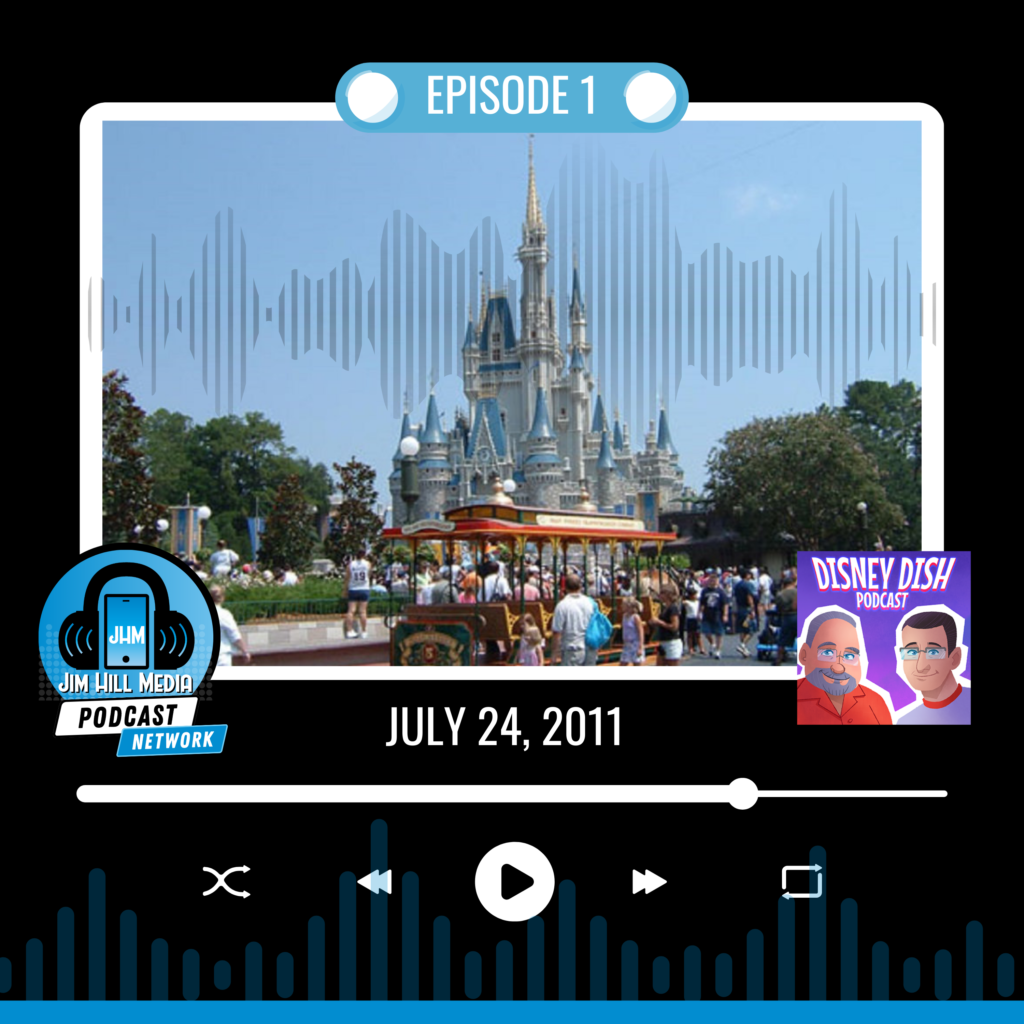
In this special on-location episode recorded in late May 2011, Len Testa and Jim Hill take a walking tour through Walt Disney World’s Magic Kingdom, sharing behind-the-scenes stories, expansion rumors, operational realities, and Imagineering history. From Main Street design psychology to early plans for New Fantasyland, interactive queues, and evolving park strategy, this episode captures a fascinating moment in Disney Parks history.
New Fantasyland Rising – Stories from a Walk Through the Park Transcript
Len Testa and Jim Hill: Hi, this is Len Testa with the Unofficial Guide to Walt Disney World and the Walt Disney World Today podcast. You know, we update the Unofficial Guide twice every year so that you always get the most accurate content possible. And the thing I enjoy most about doing those updates is to talk with Jim Hill about behind the scenes activities, what’s rumored to be happening, and all the other can’t be verified stuff in Walt Disney World. It’s a couple of hours of Jim telling stories and me laughing my head off.
Len Testa and Jim Hill: Jim and I thought it would be fun to capture the spirit of those talks for y’all to hear, and it just so happened that we were both in the Magic Kingdom at the same time one weekend earlier this year. What you’re about to hear was recorded in late May 2011. You’ll recognize where we are in the park by some of the distinctive background music too. Jim and I hope you enjoy this little tour of rumors and probably completely unverifiable innuendo. We hope you take a moment to review it on iTunes too, and send us an email please if you have any suggestions for future episodes. Enjoy the show.
Len Testa and Jim Hill: So we’re on here on Main Street, we’re over in front of the new Town Square Theater, which used to be the Exposition Hall, but the problem is Americans can’t spell exposition. But I do give them the credit because it’s theater spelled the correct way with the ER instead of R-A, which is the Autre. There you go, there you go. Actually, the interesting piece about this building, and back in the day, this was the Gulf Hospitality House, but if all had gone according to plan in 69-70 or thereabouts…
Len Testa and Jim Hill: This would have been Disney’s first in-theme park hotel. Really? Yeah, Dorothea Redmond actually gave us this amazing set of plans. In fact, if you pick up a copy of the art of Walt Disney World, they actually have a second-tier hotel. It was going to be amazing. But more to the point, it was going to be tall enough that one of the things that’s kind of interesting about why this building is positioned here and it is the height it is — so you can’t see the Contemporary.
Len Testa and Jim Hill: Oh, nice. So, I mean, it’s deliberately the tallest building, you know, bulk-wise of the ones on Main Street. But yeah, this would have been the in-park hotel, but in the end, you know, as things that were on the table that were suddenly more expensive or outside of Disney’s purview, I mean, you’ve got to remember, before Disney World opened up, Disney didn’t operate any hotels. Yeah. The Wrather Corporation ran the Disneyland Hotel. And in fact, for a long time…
Len Testa and Jim Hill: U.S. Steel was supposed to run the ones down here. They were building the Polynesian. Right, and the Contemporary, right? Yep. And they were supposed to lease them back to Disney, and Disney was going to operate them. Eventually Roy Disney just — to be honest, when U.S. Steel was building the hotels, it was kind of a conversation in July. It’s like, yeah, we’re going great. By the way, we won’t be available for the October 1st opening. And one of the reasons that the budget for Walt Disney World went ridiculously over — I mean again, this project was budgeted for 100 million, came in at 400 million — was that the company had to buy out U.S. Steel.
Len Testa and Jim Hill: Just get out. Anyway, back to Main Street. Are they doing anything with Tony’s Town Square? It’s going to stay the restaurant? Yeah, for now. The weird thing is it is destination dining. And right now, I mean, they are technically eyeballing, given the success of Main Street Theater. It’s like…
Len Testa and Jim Hill: Alright, so… The Disney Princesses are not in there forever, obviously. They’re gonna have their own Fairytale Hall. Right, everybody’s Snow White. Yes, so long term, it’s okay. Mickey’s a success. What can we do… you know, the princesses are on that side of the building. What can we do here that’s a character dining opportunity with a meet and greet thing? So, they are definitely circling that idea. But as of right now, they’re Tony’s Town Square.
Len Testa and Jim Hill: You know when you’re making that much money you don’t — that’s like why are we doing this? Yeah, and the funny thing is that would be probably the last place in the Kingdom that I would try and — well, Cinderella’s maybe. But you know for the cost actually it’s probably up there, but like I would prefer Liberty Tree Tavern and many counters. Huh, interesting. What about the Chapeau or the Confectionery?
Len Testa and Jim Hill: Well, I think we were talking about this the other day. I mean literally this is the design here. This is off of the fact that Americans are right-handed. And given the whole notion of it, you walk into the park — it’s Florida — you know if you and I with our rather large foreheads, it’s like hey I need a hat. And it’s right there. And as you proceed up the street, I need a snack, I just got here — hey, the bakery is there. Or I need film for my camera. I mean now so the stuff that you need when you’re coming in is on the right, and the stuff that you want on the way out — that’s exactly on the right coming back — is the souvenirs.
Len Testa and Jim Hill: And then it gets even more fiendish than that. That as you come in… If I wasn’t a stockholder I’d say that was evil. But since I am, it’s brilliant. Brilliant. Well, the other thing is, you know, I mean when you walk in in the morning, all right, you have march music. They are — you got 76 trombones — get your wallet out. You know, moving up the street. And the interesting thing is that now literally like five o’clock in the afternoon, they suddenly switch over to waltzes. You know, kind of medium tempo like saunter strolls. Stay, why are you going so soon? That’s right. Stay. Hey, how’s your wallet? Still good? Kind of heavy, we can lighten it for you.
Len Testa and Jim Hill: But again, what is just absolutely fascinating about this is we were this past weekend shown this amazing set of construction photos for Main Street. Yep. And honestly, you know, it’s so obvious, but it’s like — the buildings themselves are just conventional buildings. Everything here that we’re looking at, these are artificial facades that bump out away from the standard square rectangular structure. And you’ve got all these admin buildings upstairs.
Len Testa and Jim Hill: But as you can hear in the background here, they still use this as a performance space. It really clogs up Main Street too when they do that. It does. But on the other hand, again, this sense of occasion when you start early in the day…
Len Testa and Jim Hill: Are there changes to shopping? They are reviewing the opportunities. I mean, obviously we have watched the 19th century version of this in Disneyland. There wasn’t the adherence that you saw with the ’55 Disneyland. You didn’t have the actual drugstore with the leeches. But here again you don’t have the tobacco shop, you don’t have the photography place. You are looking at what else could we be doing.
Len Testa and Jim Hill: Honestly, part of the problem is that this audience — the people who are here today — they don’t connect with turn of the century. I mean, this is charming. But it’s not getting — it’s all lost on them. Yeah. I mean again, it’s one of the reasons why the Imagineers have pushed for the last couple of parks when they’ve done Magic Kingdoms.
Len Testa and Jim Hill: For example, the original plan — there were two plans for Hong Kong Disneyland. And one of them was, OK, we keep Main Street and forget about keeping the stores authentic. It’s like you walk by a turn of the century facade but it’s a Chili’s. You know, it’s a lovely ornate grillwork and it’s The Gap. But the other idea — and honestly I wish they had pursued it — was 1950s America. So it’s big fin cars and it’s, you know, you go down to the TV shop where it’s like my God they’ve got a 15 inch screen. A color TV. No, you gotta see this.
Len Testa and Jim Hill: You know, and it’s just the whole notion of Letterman sweaters, you know, that’s Richie, that’s Potsie, you know that sort of vibe. And in the end — because honestly when Hong Kong was being put forward, Eisner had fallen out of being in love with being an architecture patron. Really? Yeah. I mean just think about it. When you drive around Disney property you see so many spectacular buildings that Eisner himself put out there. But the downside is that somebody actually had to maintain those buildings.
Len Testa and Jim Hill: Anything happening with Casey’s? Well Casey’s we just tried, right? Casey’s has new hot dogs. Those are fabulous. Is there anything else happening on this end of Main Street towards the castle? Well obviously we’re now dealing with the new memory show and using the castle as performance space. That campaign is kind of a dud. Really? Well it’s certainly not doing what they expected.
Len Testa and Jim Hill: I mean for example just tonight — the Monday night — there’s a single show, 9:45. And in fact these days people are like oh, oh there’s something. They turn around while they’re moving in the park. You know, the whole notion of go stand in front of the castle and see pictures of yourself hasn’t landed. People don’t realize that.
Len Testa and Jim Hill: The concept and technology are great. Absolutely. It goes on a little long, but somebody said it best. I was with somebody at Disneyland. We were watching it get projected on Small World. And they said the exact same thing. It’s colorful, it’s pretty, it’s a great idea. But in the end, who wants to look at someone else’s vacation photos?
Len Testa and Jim Hill: There you go. And that’s the thing. They are now looking to what can we do storytelling-wise. Storytelling? That would be interesting. So like a movie or something? Well more to the effect of, for example, Mickey’s Not So Scary. The notion of okay if Maleficent takes over the castle, it’s like you can watch her wave her magic wand and literally watch the vines cover the building. You could have Madam Mim on one turret and Merlin on the other turret having a wizard’s duel.
Len Testa and Jim Hill: At this point, entertainment is storyboarding their ass off trying to find some way to do this. Yeah, because again, all of this infrastructure is in place, but as of right now, it’s just not landed.
Len Testa and Jim Hill: Yeah, I saw it once. I’ll sit here once just to see it, but it didn’t have the staying power that I thought it was. No, no, no, absolutely. Absolutely. And again, for repeatability, it’s not something — you know, it’s not something like the fireworks, which I just saw the other night. The fireworks, I have to see them again. Yeah. This is like yeah, the castle thing — got it.
Len Testa and Jim Hill: All right, so we’re on our way to Tomorrowland, and we just went through the Tomorrowland Terrace — the former Noodle Station. It’s still the Noodle Station, but any plans for that? The problem with it is — I mean, it’s a great idea, great concept, right? Asian food in the park. There was some variety. It was different. It’s not something that they normally do. I love the idea. The execution left something to be desired.
Len Testa and Jim Hill: And more to the point, I mean again, you get this constant pushback about, you know, they said the terrace area has this primo view of the castle. It does. And they would really love to be able to capitalize on it in an ongoing basis. So you do have things like the fireworks dessert parties. You do have the seasonal pieces of entertainment they do here along with the old viewing areas for the Swan Boats.
Len Testa and Jim Hill: But again, this is the problem. It’s just sort of like you have to have areas where when you have that seasonal bump of attendance — we have 30 or 40,000 more people in the park — and more to the point, they’re willing to pay a premium price for the holidays to do something like this. Because they set up buffets here during — they do, they do. But it’s just the whole notion of it means you have to leave it empty or basically underused for 300 days out of the year for the 65 days where you make money hand over fist.
Len Testa and Jim Hill: So, you know, again, we’re standing here at what, 10:30 in the morning? This is empty. I mean it’s a commanding view. It’s a beautiful view of the castle, just looking at it. Yeah, but at the same time it’s just sort of like why spend money to change this and fix this when you know one, for two months out of the year you make so much money out of this location. Just like no, leave it alone. We could spend the money wiser on things we actually need to.
Len Testa and Jim Hill: Not to say they haven’t given the menu a look at changing at the restaurant up there. It wasn’t all that long ago they served burgers out of this place. But yeah, it’s not on the list.
Len Testa and Jim Hill: All right, so we’re coming up on the main walkway between the hub and Tomorrowland. We’ve got Stitch up on our left. We’ve got Monsters Laugh Floor Comedy Club on our right. So far today, not much of a wait for either of those. Very true. But again, Tomorrowland has always, always been problematic.
Len Testa and Jim Hill: The main problem with this particular area right here, this walkway between the central hub and the Astro Orbiter, is facades. The two entrances are like 90 degree angles to the walkway. It’s not like there’s a slanted walkway. There’s nothing that beckons you in. Not like carnival barkers in New Orleans. Well, it’s not for lack of trying. I mean you’ve got Vegas-style marquees out here and they’re making the effort.
Len Testa and Jim Hill: And in fact what’s kind of intriguing is that boy, if they had gone forward with that Incredibles attraction, this would really have changed things out. Incredibles attraction? Yeah, well, there was. It’s kind of one of the sadder stories of recent Disney history.
Len Testa and Jim Hill: It’s the KUKA arm — sort of the key to the Harry Potter thing. I just had somebody explain to me the whole layout of what they were looking to do. It was amazing. They were going to literally sacrifice Laugh Floor. That was going to be your queue. And you literally go back and forth and you are in the Incredibles training facility.
Len Testa and Jim Hill: And they were going to — where the old Galaxy Palace Theater, which is now backstage parking, is — like a KUKA arm ride through. And the beauty of it was that they were going to be able to dial up — if you wanted Mr. Incredible-level extreme attraction versus Jack-Jack, you could dial it down to a kid-friendly ride. I mean it was literally interactive.
Len Testa and Jim Hill: But the beauty of it was that they were going to make one central giant Pixar Toy Story location, which they would have dumped the Buzz Lightyear riders with the Incredibles riders into one giant retail opportunity.
Len Testa and Jim Hill: Never happened. Well, part of the problem is frankly that Universal has an exclusive on the KUKA arm for five years. And then at that point it moves on. Once that’s done, Disney will get a little more aggressive with the technology. But at the same time, this really is Disney being eclipsed by Potter.
Len Testa and Jim Hill: Anything going on with Carousel of Progress as we walk by it? I got stuck on this on New Year’s Eve six times in a row in the last scene. Thankfully, the last three they turned off the audio so it was just the characters going through the motion. It was a little spooky.
Len Testa and Jim Hill: There has been a plan in place for a while now to move Carousel over to Epcot as part of Innoventions. But again, Disney has been hesitant to pull the trigger on this because it’s one of these things where there’s enough information out there about the famous thing that John Hench said about Carousel of Progress — that there’s more Walt in that attraction than anything else on property.
Len Testa and Jim Hill: But at the same time, let’s be honest here — that’s not the Walt version. This is the version with Jean Shepherd that got re-recorded in the 90s. Don’t get me wrong, he’s a fan of Christmas Story. I love the fact that there’s a Red Ryder rifle with the BB gunner cup in the stock. It’s literally on the kid’s bed in the 40s. But it’s just not a priority. At least not now.
Len Testa and Jim Hill: They’ve had meetings about can we at least get a new television in there? Can we at least update the video game? Because come on — this is ridiculous. It’s classic early 90s technology.
Len Testa and Jim Hill: So what’s going on with — we just actually passed a couple of things here. We passed the Tomorrowland stage that was the aborted home of Stitch’s Supersonic Celebration, the most bland but yet best — if by best we mean worst — on-stage show ever in the history of Magic Kingdom. What are they doing with that?
Len Testa and Jim Hill: Two words: John Carter. John Carter. Oh yeah, John Carter of Mars. You are going to see some pretty impressive work done here to promote that film. When’s it come out? That comes out next March or thereabouts. They’ve actually rotated it down to sort of the Alice in Wonderland slot that the Tim Burton movie had a year or so back with the hope that it will catch and be able to move lots of DVDs and that sort of thing.
Len Testa and Jim Hill: I mean there’s — that’s been kind of an interesting project because Disney’s made a deliberate effort to — this was supposed to be Pixar’s first live action. They began looking at the dailies and it’s like, you know, Disney can release this. So I don’t know, it’s going to be interesting to see how that one lands.
Len Testa and Jim Hill: But that supposedly holds the key to — there’ll be character encounters. In fact I think we’ve talked about how they were going to take giant-sized maquettes from the six-armed horses and warriors and that sort of thing and actually place them along the PeopleMover track to try to add some new kinetics.
Len Testa and Jim Hill: But yeah, so much of this depends on how that movie does and then in turn how much they’re willing to spend to bring it in here. Are they going to release the theme park stuff along with the movie or are they going to wait and see how the movie does? You have to shake the Magic 8 Ball on that.
Len Testa and Jim Hill: It’s kind of like what just happened with the Enchanted Tiki Room. I’m sure you heard the news that broke over this weekend. The weird thing is I called over to Imagineering ten days ago. They swore up and down, no we’re not doing anything with Tiki. We’re going to bring it back to what it was.
Len Testa and Jim Hill: But it keeps — it was going to be under new management again. And now they’re very cagey in their language. They’re getting to the effect of we’re going to be bringing back an enchanted Tiki-like attraction that pays tribute to the original.
Len Testa and Jim Hill: Part of the problem again is that Wally Boag has been in poor health for years. So many of the other people who recorded for it are gone. So you can’t really fix it. But again, the notion that here was — we’re not going to do it, we are going to do it, we’re not going to do it, we are going to do it — the 40th anniversary is coming up, we have nothing that really is tied to the original. Okay fine, we’ll do that.
Len Testa and Jim Hill: Is that what that’s going to be? Yeah. That’s their big hey we’re bringing it back for the 40th. It’ll be back up in October as our gift to the guests.
Len Testa and Jim Hill: I don’t see it staying though. As much as I love the original, it’s there in Disneyland. It’d be one of those things where I’d see it once in Walt Disney World just to see it again in Walt Disney World and that would be it.
Len Testa and Jim Hill: But see that’s the thing. That’s the frustration from a lot of the Imagineers — nostalgia won out again. That rather than doing — in fact the thing we talked about the other day — rather than doing Pirates of the Caribbean, come in here and this is where you get your parrot. Something fresh.
Len Testa and Jim Hill: Absolutely. But at the same time, it’s easier, particularly in an anniversary year, to sell nostalgia. So okay fine, we’ll spend the money. But they’re going to be very careful about what they take out. They’re not going to take out, you know — it’s amazing, the figures. But it means that if you don’t do that, you can’t do the old classic Tiki show with the fountain and all that.
Len Testa and Jim Hill: I think that’s the other thing that people just don’t understand about Imagineering — about literally how fluid things are. When a sponsor will fall out or a sponsor will make a weird demand. For example, when they brought Carousel of Progress here to Walt Disney World, about that time GE changed its slogan.
Len Testa and Jim Hill: So “There’s a Great Big Beautiful Tomorrow” — they literally turned to the Shermans like look, we have this new slogan, like now is the time to buy a new product. Could you build a song around that? But it’s a beloved song. We don’t care. So it’s like okay fine. We’ll redo the show. We’ll do the song all on the back of a demand of a sponsor.
Len Testa and Jim Hill: I think people who work in big companies understand how things change. If you’ve ever had to do a multi-year budget in a big company you totally understand how these things work. I think a lot of people who haven’t yet had that experience, it’s kind of a black box to them.
Len Testa and Jim Hill: But at the same time Disney has to own a piece of this. Of any entertainment company, they built up this cult of Walt. Walt’s tenets, how Walt did the parks. You can’t put that mythology out there and then ignore it. This is how we do things — except we don’t. Now give us your money.
Len Testa and Jim Hill: So that’s a frustration. But on the other hand, they sell books, they sell videos, they sell DVDs with Walt out there saying this stuff. They can’t help but have people say, why are you not doing that?
Len Testa and Jim Hill: Is there anything going on with Space Mountain? As of right now, just if it ain’t broke don’t fix it. They’ve freshened it up. It’s kind of — we’re standing outside of Tomorrowland Speedway right now. There has been a Cars-themed overlay on the table, off the table, on the table for three years now.
Len Testa and Jim Hill: This is one of the more obvious overlays. I don’t understand why they’re not doing that. To be honest it’s kind of a turf war. Walt Disney Studios long term — we’re talking 2016-2017 — will get Cars Land, the new land that’s being built for California Adventure. So the notion is that’s where you’ll go see the Cars characters. You’ll be able to ride inside of them.
Len Testa and Jim Hill: So they’re the ones who sort of threw themselves in front of the Cars characters being brought over to Tomorrowland. That’s 2016, it’s 2011. You could still run it for five years. You’re thinking rational again, Len. You have to remember how these people operate. The VPs of the individual parks are ridiculously competitive when it comes to money to build new attractions.
Len Testa and Jim Hill: So we’re overlooking it. We’re looking over at the new layout for the back end of the Tomorrowland Speedway — sort of the offloading part. They redid the track because of the Tomorrowland Transit Authority and the Fantasyland expansion.
Len Testa and Jim Hill: We’re looking over now — can sort of see what’s left of the Barnstormer, which is going to be the Great Goofini. Yes it is. And then we see the circus tent from Storybook Circus. I don’t know, it could just be my poor architectural eye. It looks a lot like the Toontown Hall of Fame tent, but I could be wrong. I’m sure there’s some sort of difference there.
Len Testa and Jim Hill: No subtle difference whatsoever. And again — hey, we got a tent. What can we do with it? Let’s go back to the archives. What films involve tents? Tents, tents, tents.
Len Testa and Jim Hill: Well, you know, when you get right down to it, honestly, the reason this building is still standing is that is where County Bounty was housed. County Bounty — the store — was second only to the Emporium on property for sales of merchandise. Wow. And literally the retail folks just — it was one of these things. All right, we’re going to flatten that. We’re going to put this into the — are you high? Are you crazy?
Len Testa and Jim Hill: So they threw themselves in front of that and actually that in a lot of ways forced the whole Storybook Circus development because it was one of the last areas to be fleshed out in terms of the expansion.
Len Testa and Jim Hill: And still what you look at — the article — what goes here? Nobody knows. They are deliberately being vague because frankly a lot of this is still very much up in the air.
Len Testa and Jim Hill: In a lot of ways it’s an empty victory to keep the equivalent of County Bounty here. I mean this is where they’re going to put in Big Top Souvenirs. And the gimmick is you’re going to be standing there under the Three Little Pigs who are going to be doing a high wire act over your head. It’s actually some limited movement AA figures. It’s going to be kind of cool.
Len Testa and Jim Hill: But the reality is that building store did as well as it did because parents were trapped there waiting for their children to go through the princess and character photo op. And now there is no character photo op tied to that. It’s not going to do the same numbers unless they bring one back in.
Len Testa and Jim Hill: Trust me, they are looking. They’re going to be doing play testing for a Dumbo-based character greeting. But honestly it’s like stand next to the giant elephant, honey.
Len Testa and Jim Hill: So on this side, what’s this sort of construction stuff that’s immediately to the left of Storybook Circus? We’re actually looking at a little bit of back-of-the-house stuff for Mermaid. There will be rock work to cover up some of that. You’re going to enter through a portal — we’re sort of loitering in the exit area for here — but there’ll be a portal roughly in this area for the Storybook Circus thing.
Len Testa and Jim Hill: Over by Mad Tea Party. That’ll blend out and be a logical transition from the Little Mermaid area. Mermaid is going to be pretty cool, but at the same time they want it to be a people-eater and they’re still adjusting the ride time. We’ve heard somewhere between five and a half and eight minutes is what they’re playing with. They’re going to hit six and a half.
Len Testa and Jim Hill: And that’ll be around what, 1700 to 2000 people an hour? It’s still going to be amazing. And you’re going to have your character meet and greet component in some of the caves coming off of this thing, coupled with retail. Again, it’s a one-stop shop for the Mermaid fans.
Len Testa and Jim Hill: By the way, we’re in the great expansive — this is sort of the DMZ, the no man’s land between. So we’re over by Winnie the Pooh right now, and there’s a bunch of stuff over — well essentially it’s a construction wall that goes from Mad Tea Party through the end of — this literally this weekend I got the story as to why this is a sea of concrete.
Len Testa and Jim Hill: You are literally right here now standing over the tunnels. Really? We’re over the tunnels? All right. That explains why the concrete is cracking the way it is. But the other issue here is that this is why this has had little to no green space forever. You had the lagoon here for 20,000 Leagues.
Len Testa and Jim Hill: In fact that’s one of the components. We’re looking at some of the placeholder trees now that will eventually be dropped into spots all over the Fantasyland Forest thing. They’re hoping to up the green and more to the point create more shade and get people to linger over here.
Len Testa and Jim Hill: Because ultimately again this is what this is all about. They want you to stay deep back in the park, spend money on food, merch. But this right now is nothing but a sea of concrete. We’re actually in the middle of the concrete and you can feel the heat.
Len Testa and Jim Hill: As I was saying earlier, we’re looking ahead at Dumbo. And again that’s going fairly shortly. Picture a wall cleaved down the middle of that and from this point forward is the Fantasyland Forest. So trees come up here and plants and walkways.
Len Testa and Jim Hill: So we can kind of see through some of the trees the stuff that’s going on with Fantasyland. Belle’s castle — that’s it exactly. You’re seeing your faux mountain range being put into place now. Made out of genuine faux.
Len Testa and Jim Hill: The space we’re staring into now is where Seven Dwarfs Mine Train will go. Literally is the attraction that sits between Big Thunder and the Great Goofini. It’s a younger kids style attraction, but instead of one hill and one run-out like Barnstormer, and three like Big Thunder, this is really two hills and a run-out.
Len Testa and Jim Hill: And the portion in the middle entry — they confirmed cameo by Snow White and alluded to the fact you may see the witch. Definitely a go.
Len Testa and Jim Hill: And again, this is really about capacity. This is about that whole notion of creating attractions that will pull people deep into the park and keep them here. And more to the point, giving them something that sits comfortably between Barnstormer and Big Thunder. Because there really hasn’t been that bridge attraction.
Len Testa and Jim Hill: So from this angle you can kind of see where Beast’s Castle is going to sit. That’s actually the restaurant. And that’s the other thing people forget. That’s not the ride. That’s Be Our Guest. And that is going to be a table service restaurant at night, quick service during the day.
Len Testa and Jim Hill: They’re betting heavily on that. It’s one of the most ambitious restaurant projects they’ve ever done inside a theme park. Three separate dining rooms, the West Wing with the rose, the ballroom with snow falling outside the windows, and then the library gallery room. They’re really going for atmosphere.
Len Testa and Jim Hill: But again, throughput. That’s the key. That’s always the key. Can we get enough people in and out? Can we turn tables fast enough? Can we make this work operationally? Because you can build the most beautiful space in the world, but if it can’t handle the volume, it’s a problem.
Len Testa and Jim Hill: And right next to that is Belle’s Enchanted Tales. Which, by the way, is fascinating from a design standpoint. This is a 40-minute character interaction experience. That’s long. That’s really long for a theme park.
Len Testa and Jim Hill: But what they found in testing was that little girls, especially, would do this over and over again. They didn’t mind the wait because they became part of the show. You get assigned a role, you go through the magic mirror, you help retell the story. It’s immersive.
Len Testa and Jim Hill: The concern, though, is scalability. How many guests per hour can you really push through something that intimate? That’s always the tension between storytelling and operations.
Len Testa and Jim Hill: And then over here, this whole stretch where the construction walls are — that’s where Gaston’s Tavern is going to go. Which I love conceptually. No Belle merchandise. No Beast merchandise. It’s all Gaston. It’s antlers and turkey legs and giant cinnamon rolls.
Len Testa and Jim Hill: That’s actually one of the smartest parts of this expansion. They’re not just building rides. They’re building retail ecosystems. You exit Mermaid, there’s merch. You exit Mine Train, there’s merch. You go through Be Our Guest, there’s merch. It’s all connected.
Len Testa and Jim Hill: And speaking of exit-through-retail, that’s what they’re doing over at Haunted Mansion too. The interactive queue is only part of it. They’re also building a dedicated shop.
Len Testa and Jim Hill: The queue is fascinating. The notion of “Do you want to go the fast way or the fun way?” That’s the choice they’re experimenting with. You can bypass the interactive elements or you can engage with them.
Len Testa and Jim Hill: But they’re still trying to figure out how to explain that to guests. Because some people just want to check it off the list. Others want to play with the xylophone made of bones.
Len Testa and Jim Hill: That bone xylophone is great. The Ravenscroft Model 5000. I love the key play on that. It’s those little touches that make it work.
Len Testa and Jim Hill: But the larger strategy is this: they are spending $500 million on queues. Not rides. Queues. Because guest satisfaction scores show that perceived wait time matters more than actual wait time.
Len Testa and Jim Hill: If you’re entertained, if you’re engaged, you don’t mind standing there as much. And if you don’t mind standing there as much, you’re happier. And if you’re happier, you spend more money.
Len Testa and Jim Hill: That’s the system. It’s all connected.
Len Testa and Jim Hill: And then you layer on top of that the FastPass evolution. They’re looking at tiered systems. They’re looking at tying it to resort stays. They’re looking at priority dining incentives.
Len Testa and Jim Hill: If you lock yourself into a park day in advance, that helps them forecast staffing. It helps them schedule performers. It helps them manage food inventory. That’s why they care about advance commitment.
Len Testa and Jim Hill: Guests think it’s about convenience. And it is. But operationally, it’s about predictability.
Len Testa and Jim Hill: And as we walk back toward Liberty Square here, you can see how everything funnels. That’s deliberate. Every pathway is engineered to manage flow.
Len Testa and Jim Hill: So we’re heading past Haunted Mansion now, and this is where that new queue really changes the dynamic of this corner of the park. Because before, this was just switchbacks. Now it’s interactive. Now it’s kinetic. Now it’s something you actually want to experience.
Len Testa and Jim Hill: And that’s the interesting thing — they’ve essentially created a pre-show before the pre-show. By the time you get into the stretching room, you’ve already been entertained for fifteen or twenty minutes.
Len Testa and Jim Hill: And again, this is about repeatability. If you can give someone a reason to go back through the left side of the queue because there’s a treasure they didn’t find, or an effect they didn’t trigger, suddenly you’re getting two rides out of one guest impulse.
Len Testa and Jim Hill: There was even talk at one point of capturing your own ghost at the end of the attraction. That seems to have backed off. But over at Pirates, the magical compass idea — the notion that you’d have an app that interacts with the environment — that’s still floating around.
Len Testa and Jim Hill: The Sparrow compass. Exactly. You wave it around and it points toward hidden treasure. That kind of thing. That’s the direction they’re heading. Blending physical sets with digital interactivity.
Len Testa and Jim Hill: And again, this is why the whole “fun way versus fast way” concept is so important. Some guests want maximum efficiency. Others want maximum immersion. Disney’s trying to give both without breaking capacity.
Len Testa and Jim Hill: But capacity always wins. That’s the rule. If an effect slows down loading, it goes away. If a show scene reduces hourly throughput, it gets reworked.
Len Testa and Jim Hill: And you see that philosophy even in small things. The post-show retail space here at Haunted Mansion — that’s intentional. You exit into merchandise. You just experienced something emotional. Now you can buy a memento.
Len Testa and Jim Hill: It’s smart business. It’s also classic theme park design.
Len Testa and Jim Hill: As we move back toward Frontierland, you can see how Big Thunder acts as a weenie for this side of the park. It pulls you in. Just like the castle pulls you down Main Street.
Len Testa and Jim Hill: And that’s the other fascinating thing about this whole expansion. They’re essentially creating new weenies in Fantasyland. Beast’s Castle on the hill. The Mine Train mountain range. These visual icons that draw you deeper.
Len Testa and Jim Hill: Because historically, Fantasyland was a cul-de-sac. You went in, you rode Peter Pan, you rode Small World, you left. Now they want it to be a destination you linger in.
Len Testa and Jim Hill: Shade helps. Trees help. Seating helps. Food helps. All of that encourages dwell time. And dwell time equals spending.
Len Testa and Jim Hill: That’s the unromantic truth behind a lot of this. It’s storytelling, yes. But it’s also economics.
Len Testa and Jim Hill: And as we loop back toward the hub, it’s kind of amazing to think how much of this is still in flux. Plans change. Budgets shift. Sponsors intervene. Movies hit or flop.
Len Testa and Jim Hill: But the through line is this — the park is never static. It’s a living thing. It evolves. Sometimes in big half-billion-dollar swings like this expansion. Sometimes in subtle queue tweaks or retail additions.
Len Testa and Jim Hill: And that’s why it’s fun to walk it. Because if you pay attention, you can see the future under construction.
Len Testa and Jim Hill: And sometimes you can see the past peeking through too.
Len Testa and Jim Hill: So that’s our stroll through the Magic Kingdom. A snapshot of where things stand in 2011, with New Fantasyland rising and a lot of other moving pieces behind the scenes.
Len Testa and Jim Hill: Thanks for walking with us.
Support the Show
- Leave a Review on Apple Podcasts
Support Jim Hill Media on Patreon at https://patreon.com/JimHillMedia.